Identity
The person or organization being represented. Identity answers who or what the information is about; it is not the same as any one profile or presentation.
Site controls use English here. Journal articles use the selected language where available.
This page is currently available in English. Your selected language is kept for navigation.
Engineering · Core concept
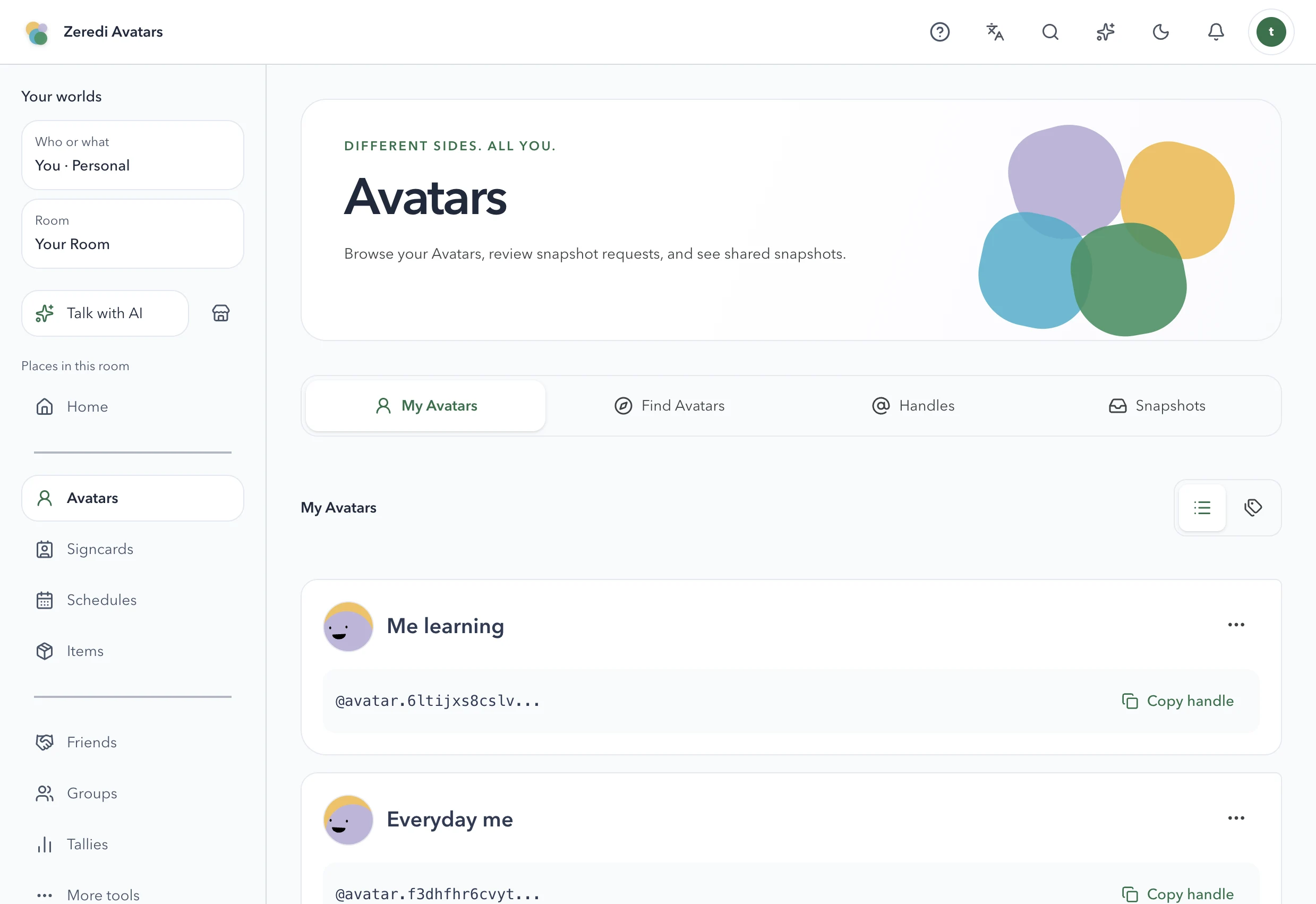
Zeredi Avatars starts with a simple distinction: an identity can be the same while the context in which it appears changes. An avatar is a context-specific way to represent that identity—not a complete profile or a separate person.
The person or organization being represented. Identity answers who or what the information is about; it is not the same as any one profile or presentation.
A way that identity is represented for a particular context. It brings forward what is relevant to that situation without claiming to express the whole identity.
A structured set of related information that may be useful in one or more contexts. An avatar can draw on selected Signcards; relevance alone does not grant access.
A travel context might make a preference for a quiet room useful. That does not make unrelated work or dining details relevant, and it does not turn a past choice into a permanent instruction.
A business context might bring forward services, appointment preferences, or practical details. A supplier conversation could call for different information from the same business.
Here, “avatar” does not mean only a picture or character, nor does it mean a chatbot or autonomous agent. It describes the role of representing an identity in context.
Representation and permission are separate. Describing what might be relevant does not itself authorize someone to read, change, share, or act on that information.
This page describes the design direction behind Zeredi Avatars. It is a conceptual model, not a promise that every context, connection, permission, or workflow is available today.
How Signcards organize related information