This page is currently available in English. Your selected language is kept for navigation.
Engineering direction · Signcards
Signcard is Zeredi’s unit of reusable context.
Related information. Reusable context. Without asking one profile to speak for your whole life.
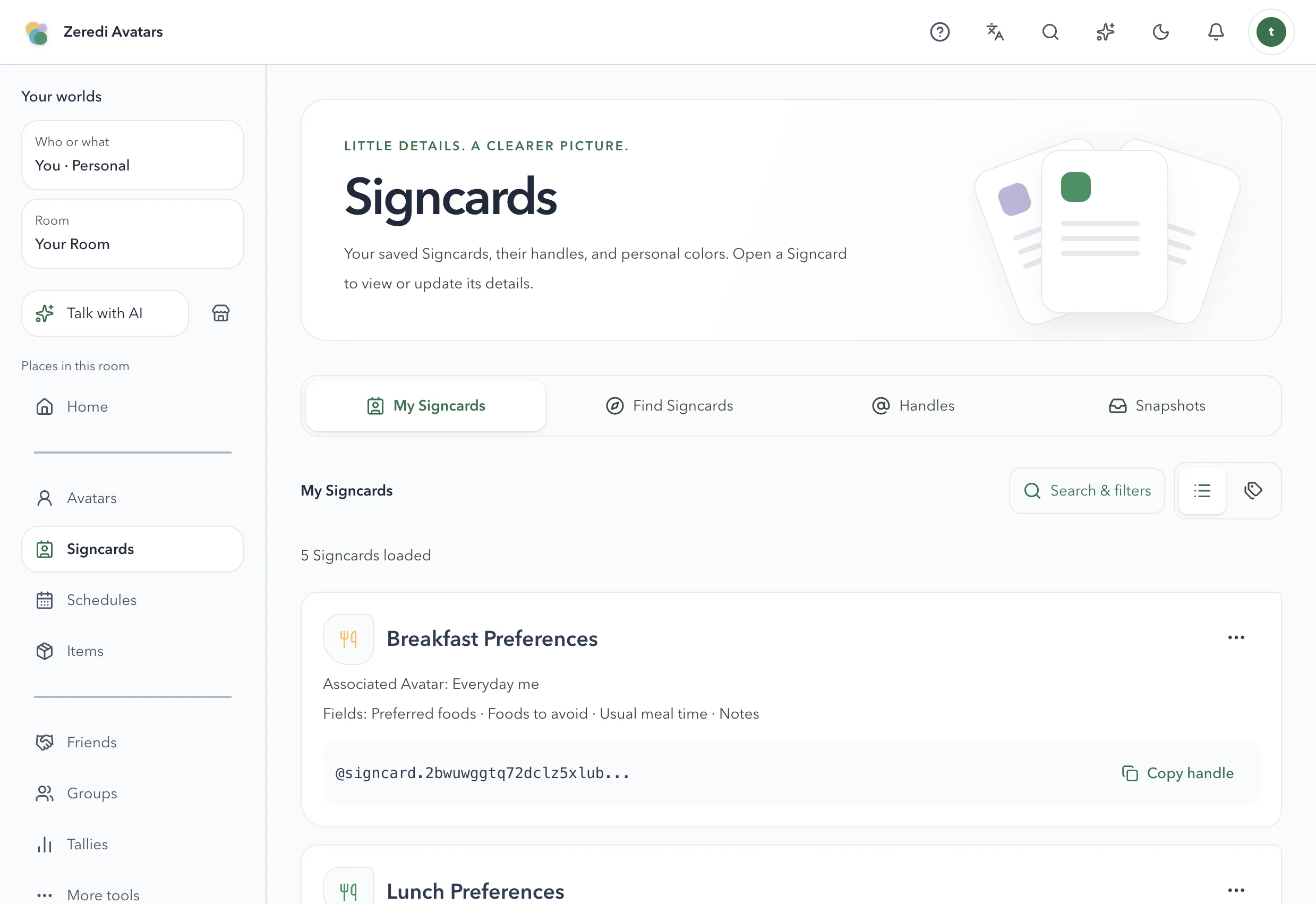
What is a Signcard?
A Signcard brings a meaningful set of related information together. Modular, structured data—not a definition of the person.
The boundary is what belongs together, not everything about you.
How is a Signcard different from a profile?
A profile often brings information together to present someone within an app or service. A Signcard has a narrower role: organizing related information that can be relevant in different situations. In Zeredi's intended model, avatars bring different sides of an identity into context; Signcards provide the information those contexts draw on. Neither is meant to represent the whole person.
A simple way to organize related information.
If you can lay it out in a spreadsheet, you can start imagining it as a Signcard. A label, a value, and a few related details—not your whole identity in one sheet.
| Label | Value |
|---|---|
| Name | A sample name |
| Note | A short description |
Organizing information does not automatically share it.
Different labels. The same information.
An app might display "Name" in English or "Nombre" in Spanish. Changing the label's language does not, by itself, change the value someone entered.
Translation still needs care. A translated label does not automatically translate someone's answer or guarantee the same meaning in every context.
Explore Signcards across languagesCan the same Signcard be used in different contexts?
Yes, in the intended model. Information can matter in more than one situation without being relevant everywhere.
Reuse the information instead of recreating it. Each use would still need the right scope and permitted access.
Relevance is not permission. Reuse does not guarantee an outcome.
Does a Business Have an Avatar Too? Signcards for business contextsDoes selecting a Signcard automatically share it?
No, not in the intended model. Recording information, bringing it into an avatar context, and granting someone access are separate decisions. Permission to read information would not automatically authorize changing it, passing it onward, or taking action on someone's behalf.
Recording a Signcard is not consent to share it. Identity, a service request, or a matching result would not by itself grant access. The intended direction is scoped use: only the permitted data for the requested purpose. Reading, changing, and passing it to another person, service, or agent would require their own appropriate permissions.
How could an AI agent use a Signcard?
The right context, not your whole life story. An AI assistant could use information you deliberately make available instead of guessing from a complete profile. A suggestion is not a confirmed preference.
Access is not authority to act. These are proposed uses, not currently available third-party connections.
Explore the AI-agent design directionThis explains the engineering concept, not a finalized schema, transfer protocol, or available integration. The public demos use fictional fixtures; they do not create, save, retrieve, or pass Signcards or avatar data.